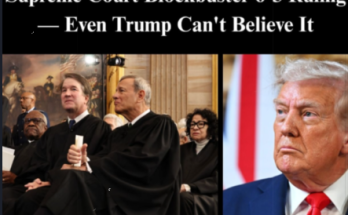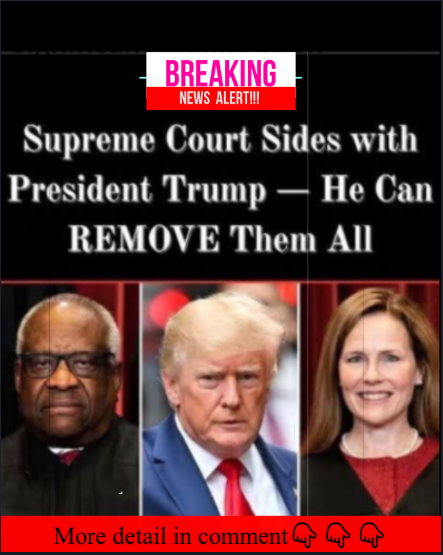
In a ruling with far-reaching consequences for U.S. immigration policy, the Supreme Court of the United States has handed the Trump administration one of its most consequential legal victories to date. By an overwhelming 8–1 margin, the Court lifted a lower-court injunction that had blocked the federal government from ending Temporary Protected Status (TPS) for hundreds of thousands of Venezuelan nationals living in the United States.
The decision effectively clears the legal path for the administration to proceed with terminating protections that were granted under previous administrations, marking a decisive shift back toward executive authority over immigration matters. Notably, the ruling drew support not only from conservative justices but also from members of the Court typically aligned with its liberal wing—underscoring the strength of the administration’s legal position.
Only one justice dissented, Justice Ketanji Brown Jackson, highlighting just how broad the Court’s consensus was on this issue.
What the Court Decided
At the heart of the case was whether federal courts could block the executive branch from ending TPS designations—programs that grant temporary legal status to foreign nationals whose home countries are deemed unsafe due to war, natural disaster, or extraordinary conditions.
The Supreme Court ruled that the lower court overstepped its authority by issuing an injunction that prevented the administration from carrying out a discretionary immigration decision. In doing so, the justices reaffirmed a long-standing principle: immigration policy, especially decisions involving foreign policy and national interest, lies primarily within the executive branch’s constitutional powers.
The ruling immediately dissolves the injunction that had protected approximately 300,000 Venezuelan migrants from removal and allows the Department of Homeland Security to move forward with enforcement actions consistent with federal law.
A Major Shift in Immigration Authority
This decision represents more than just a procedural victory—it reasserts the boundaries between the judicial and executive branches.
During oral arguments, Solicitor General John Sauer argued that the district court’s ruling amounted to judicial micromanagement of immigration policy. The Supreme Court agreed, emphasizing that TPS decisions involve sensitive assessments of diplomatic relations, border integrity, and national security—areas where courts traditionally defer to the executive.
In its reasoning, the Court pointed out that TPS was never intended to be permanent and that Congress deliberately gave the executive branch broad discretion to designate—and terminate—protected status when conditions change.
Background: Temporary Protected Status and Venezuela
Temporary Protected Status for Venezuelans has undergone several expansions over the past decade. Initially introduced as a humanitarian response to political instability and economic collapse in Venezuela, TPS was repeatedly extended under the Biden administration.
However, earlier this year, Kristi Noem, the Secretary of Homeland Security, issued a formal determination concluding that Venezuela no longer met the statutory requirements for TPS under the 2023 designation.
In a detailed memo, the Department stated that continuing TPS for Venezuelans was “contrary to the national interest,” citing evolving country conditions and broader immigration enforcement concerns.
That determination became the subject of immediate legal challenges, culminating in the now-overturned injunction.
Why the Supreme Court Sided With the Administration
Legal analysts note that the Court’s decision aligns closely with precedent. Historically, federal courts have been reluctant to interfere with executive immigration determinations unless there is a clear violation of statutory or constitutional law.
In this case, the Court found no such violation.
Justice Brett Kavanaugh, writing for the majority, underscored that TPS is fundamentally temporary, not a pathway to permanent residence. He emphasized that allowing courts to indefinitely block termination decisions would effectively convert a discretionary humanitarian tool into a permanent immigration program—something Congress never authorized.
The majority opinion also rejected arguments that terminating TPS would automatically expose migrants to unsafe conditions, noting that immigration law provides other mechanisms—such as asylum—for individuals facing individualized threats.
Political and Policy Implications
The ruling is being hailed by the Trump administration as a validation of its broader immigration strategy, which emphasizes enforcement, executive discretion, and the rollback of expansive Biden-era programs.
President Donald Trump has repeatedly argued that mass TPS extensions contributed to strained housing markets, increased pressure on public services, and weakened border enforcement. This decision strengthens the administration’s position ahead of upcoming legislative and electoral battles.
Supporters argue that restoring executive control over TPS helps reestablish the rule of law and prevents temporary programs from becoming de facto amnesty policies.
Critics, however, warn that the ruling could lead to large-scale removals and humanitarian challenges, particularly for families who have lived and worked in the U.S. for years.
What Happens Next for TPS Holders
With the injunction lifted, TPS protections for Venezuelans under the 2023 designation can now legally expire. The Department of Homeland Security is expected to issue formal guidance outlining timelines, enforcement priorities, and compliance procedures.
It is important to note that the ruling does not mandate immediate deportations. Individuals affected may still pursue other legal avenues, including asylum claims or status adjustments if eligible.
Nonetheless, the decision significantly narrows the legal shield that had previously protected TPS holders from removal.
A Broader Message From the Court
Beyond immigration, the ruling sends a clear institutional message: federal courts are not policymaking bodies.
By siding so decisively with the executive branch, the Supreme Court reaffirmed limits on judicial intervention in areas where the Constitution grants discretion to the president and federal agencies.
Legal scholars view this as part of a broader trend in which the Court is reining in expansive interpretations of judicial power—particularly in administrative and regulatory cases.
Conclusion
The Supreme Court’s ruling marks a pivotal moment in modern U.S. immigration law. It restores executive authority over Temporary Protected Status decisions, dismantles a major legal obstacle facing the Trump administration, and reshapes the future of TPS nationwide.
Whether viewed as a restoration of constitutional balance or a setback for humanitarian policy, the impact of this decision will be felt for years to come—by policymakers, migrants, and the courts alike.
One thing is clear: the era of courts unilaterally freezing major immigration decisions may be coming to an end.