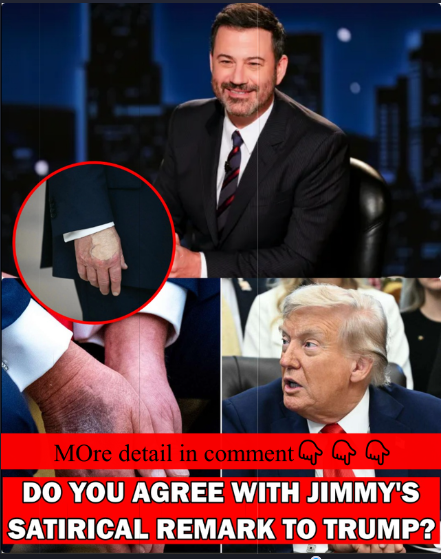
In a razor-sharp monologue on Jimmy Kimmel Live! this week, comedian Jimmy Kimmel did not hold back, shining a relentless spotlight on President Donald Trump’s health, sending shockwaves through American audiences and leaving fans gasping, laughing, and cringing all at once.
Kimmel opened with a pointed, biting question: “Something is wrong. The guy who’s running our country is being given unscheduled dementia tests. He’s being given MRIs. He has mystery bruises he’s covering with Maybelline. And we’re supposed to accept this idea that he’s some cross between Chris Hemsworth and Albert Einstein?!”
In other words, according to Kimmel, something is seriously off in the White House. The man tasked with leading the most powerful nation on Earth is reportedly undergoing unscheduled cognitive tests
, being scanned with MRIs, and appearing with odd bruises on his body, which Kimmel sarcastically notes are “masked” with the popular makeup brand Maybelline.
Kimmel took the mockery even further, suggesting that
Americans are being asked to believe that Trump is a miraculous hybrid of Chris Hemsworth—the very picture of masculine health—and Albert Einstein—the ultimate symbol of intellect. He highlighted the absurdity of expecting the public to accept that someone showing these strange health signals and mysterious bruises could somehow embody the perfect mix of strength and genius.
This jab is more than just comedy; it’s a direct strike at Trump’s carefully curated public image, which has faced intense scrutiny in recent months. Unusual bruises, awkward public moments, and medical tests outside the usual schedule have been heavily documented by media outlets, giving Kimmel and other late-night comedians a treasure trove of material to satirize.
Trump himself has repeatedly claimed to have scored perfectly on cognitive assessments and has labeled questions about his health as “unpatriotic.” Yet Kimmel seems unimpressed, emphasizing that Trump’s public persona
resembles a bizarre Hollywood-Harvard mashup, where Chris Hemsworth and Albert Einstein inexplicably merge into a single, improbable figure.
Not stopping at words alone, Kimmel painted vivid imagery of the mysterious bruises Trump allegedly covers with heavy makeup
, prompting audiences to wonder: are these marks simply the result of a stressful political life, or is there something more sinister at play? Fans of the show have eagerly posted images and clips online, pushing hashtags like #TrumpBruises and #KimmelRoast to trend on Twitter and TikTok for days.
Kimmel’s monologue has gone viral, racking up thousands of shares and comments, from people laughing uproariously at the sharp comedic strike to Trump supporters decrying the segment as “malicious and over the top.” Regardless of perspective,
Jimmy Kimmel has delivered one of the most hilarious, cutting, and direct attacks on a sitting U.S. president’s public image in recent history.
At a time when Americans are increasingly concerned about
the physical and mental health of national leaders, Kimmel’s stinging commentary is more than entertainment—it’s a wake-up call, reflecting the harsh reality that the public image Trump projects may be carefully constructed, selectively revealed, and far from transparent.
One thing is certain: with Jimmy Kimmel’s merciless satire, all of America is now looking at the White House with a mix of laughter and skepticism, asking whether the so-called “Chris Hemsworth meets Einstein” is really running the country—or if it’s all just an elaborate comedic illusion fueled by media spectacle and social media frenzy.
After the game against the Boston Fleet, Kendall Coyne Schofield accidentally dropped her puck onto the ice. A young girl named Sofia, who was working as part of the arena’s cleanup crew to help support her family and take care of her younger brother, Louis, quickly picked it up and handed it back to her. 005
On a chilly December night in Lowell, Massachusetts, the Boston Fleet had just fallen 3-2 in a heart-pounding overtime battle against Minnesota. The Tsongas Center crowd was still buzzing as players skated off the ice, sticks raised in appreciation.
Among them was Kendall Coyne Schofield, the 33-year-old American hockey icon, three-time Olympian, and one of the most decorated players in women’s hockey history.
As she made her way toward the tunnel, the ceremonial puck she had used for the pre-game face-off slipped from her glove and clattered onto the ice.
Most players would have kept walking. Most nights, the puck would have been swept away with the snow and forgotten. But this was not most nights.
A young girl in an orange arena-crew vest darted out from the boards. Sofia Ramirez, 16 years old, was one of the cleanup crew members who stay long after the fans leave, picking up programs, wiping down seats, and shoveling ice, all to help her single mother keep the lights on at home.
Sofia scooped up the puck with the quick hands of someone who had done this a thousand times and skated it over to Coyne Schofield.
“Here you go, ma’am,” she said softly, holding it out.
Kendall stopped. She looked at the teenager’s calloused hands, the name tag that read “SOFIA,” and the quiet pride in her eyes. Something shifted in the captain’s expression.
“What’s your name?” Kendall asked.
“Sofia.”
“Do you have a brother or sister who likes hockey?”
Sofia hesitated, then nodded. “My little brother Louis. He’s nine. He watches every Fleet game on the old TV at home. He… he really looks up to you.”
Kendall smiled the kind of smile that doesn’t need cameras to be genuine. She took the puck from Sofia, turned it over in her hands, and then pressed it back into the girl’s palm.
“Keep this one,” she said. “And bring Louis to the next game. I’m leaving two VIP tickets and backstage passes at will-call for you both. All-access. You’ll watch warm-ups from the bench, and then after practice tomorrow, Louis is going to get a private lesson from me. Just him.”
Sofia’s eyes filled with tears. She tried to say thank you, but the words wouldn’t come. All she could do was nod, clutching the puck like it was made of gold.
Twenty-four hours later, the video was everywhere.
Someone in Section 108 had captured the exchange on their phone. By morning, the clip—set to soft piano music and slow-motion replays—had exploded across TikTok, Instagram, and X. ESPN ran it on SportsCenter. NHL Network replayed it between periods. Good Morning America called it “the feel-good moment of the hockey season.”
But the real magic happened the next day at the Fleet’s practice facility.
Louis Ramirez arrived wearing a hand-me-down jersey two sizes too big, the name “COYNE” written in crooked Sharpie letters across the back because the family could never afford an authentic one. His eyes were the size of dinner plates when Kendall Coyne Schofield skated over, crouched down to his level, and said, “You ready, buddy?”
For the next forty-five minutes, the Tsongas Center ice belonged to a nine-year-old boy and a living legend.
Kendall started with the basics. She showed Louis how to cup the puck gently on his blade, how to keep his bottom hand loose for stickhandling, how to transfer weight for a snapshot.
Every time Louis wobbled or fell, she was there with a hand or a laugh. When he finally roofed a shot top corner—barely hard enough to make the net move—he threw his arms in the air and screamed, “I scored on Kendall Coyne!” The handful of teammates watching from the bench erupted in applause.
Sofia stood behind the glass, phone in one hand, the original puck in the other, tears streaming down her face. This time she wasn’t working. This time she was just a big sister watching her little brother live a dream she never dared dream for him.
After practice, Kendall signed Louis’s jersey—this time with a real marker—and posed for photos. She told Sofia, “You’re doing something really special for your family. Keep working hard. This game needs more people like you.”
As the siblings left the rink, Louis turned back one last time and shouted, “Thank you, Captain!” Kendall waved, her eyes visibly glassy even through the cage of her helmet.
By the time the Fleet’s next home game rolled around, the story had taken on a life of its own. The Jumbotron showed a beautifully produced tribute video before puck drop.
When Louis and Sofia’s faces appeared on the screen—Louis in his now properly fitting Coyne jersey, Sofia beaming beside him—the entire arena rose for a standing ovation.
Strangers in the concourse bought them hot chocolate. A season-ticket holder in the row behind them handed Louis a game puck from the warm-up “because every kid deserves more than one.”
Kendall Coyne Schofield has won Olympic gold, World Championship MVPs, the Patty Kazmaier Award, and nearly every accolade women’s hockey offers. But on this December weekend in 2025, she reminded everyone why she is beloved far beyond statistics and highlight reels.
In an era when professional sports can sometimes feel transactional, when ticket prices climb and the gap between athletes and fans widens, Coyne Schofield reached across that divide with both hands. She saw two kids who needed to be seen, and she refused to let them stay invisible.
The puck that started it all now sits in a small shadow box in the Ramirez living room, next to a photo of Louis and Kendall on the ice together. Beneath it, in Kendall’s handwriting, are the words: “To Louis and Sofia—keep chasing the dream. Love, your captain.”
In a season full of goals and saves, this was the moment that scored deepest.
Sometimes the most powerful plays in hockey don’t happen between the whistles. Sometimes they happen after the game, when a puck slips from a glove and lands in the right hands—at exactly the right time.