From Trafficking Horrors to Forced Labor, Border Chief Homan Details Administration’s Quiet Campaign to Reclaim Lost Children
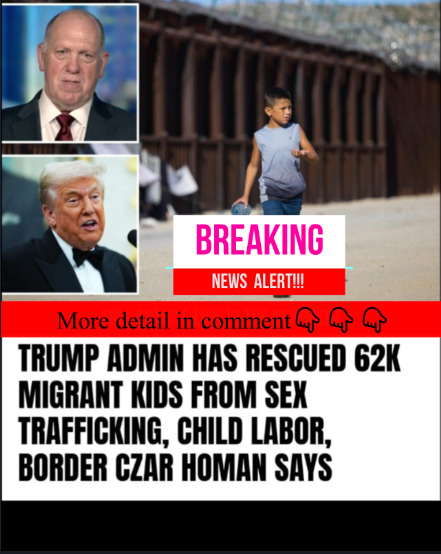
In the hushed sanctuary of a nondescript office building in Phoenix, Arizona, where the soft click of keyboards and the murmur of case files being shuffled create a rhythm of determined resolve, 42-year-old caseworker Elena Ramirez reviewed the latest intake report on a rainy December morning in 2025, her eyes lingering on the photo of a 12-year-old girl from Honduras, her smile tentative but bright in the glare of a shelter flash. Ramirez, a social worker with the Department of Health and Human Services’ Office of Refugee Resettlement, had seen hundreds of unaccompanied minors cross into her caseload since the border surges of 2021, their stories a mosaic of escape and endurance—from fleeing gang threats in San Salvador to enduring journeys through the Darién Gap. But this girl’s file carried a new notation: “Recovered from forced labor, November 2025—safe housing secured.” For Ramirez, who balances home visits with her own two children’s school runs, the detail wasn’t just bureaucracy; it was a small victory in a system strained by loss, a reminder that behind every statistic lies a child reclaiming their childhood. The rescue, one of over 62,000 migrant minors freed from sex trafficking, forced labor, and abuse since the Trump administration took office, was shared publicly on December 8, 2025, by Border Czar Tom Homan during a “Fox & Friends” interview, his voice steady with the quiet pride of a man who’s dedicated his career to the front lines. In a nation where the plight of unaccompanied children has tugged at heartstrings and sparked heated debates, Homan’s announcement wasn’t fanfare; it was a profound affirmation of effort amid the shadows, a story of lives pulled from danger that honors the vulnerability of those who cross borders not for fortune, but for a future free from fear.
Homan’s revelation, delivered with the measured gravitas of a 30-year veteran of Immigration and Customs Enforcement, came amid a year of intensified focus on the welfare of the half-million unaccompanied minors who entered the U.S. during the Biden years, many lost to tracking after release to sponsors. “Over half a million children were smuggled into this country under Joe Biden,” Homan said, his words a stark ledger of the crisis, with 300,000 unaccounted for according to a 2024 Department of Homeland Security report that found ICE released 291,000 children without court notices or follow-up from fiscal 2019 to May 2024. “We know many of them are in sex trafficking. Many are in forced labor. Many are being abused.” The 62,000 rescues, spanning January to December 5, 2025, represent the administration’s response—a multi-agency push involving ICE, HHS, and the FBI, targeting high-risk sponsors and networks that exploit the vulnerable. Homan, Trump’s border czar confirmed in a 54-46 Senate vote on February 28, 2025, credited the president from “day one” with prioritizing the effort: “Like or love President Trump, you got to admit, this man has shown every day he’s saving America.” For Ramirez, reviewing her files that morning, the numbers brought a swell of relief tinged with sorrow—the girl in the photo, trafficked into domestic servitude in Phoenix after a 2023 crossing, was one of 12,000 recovered from labor rings, her story a quiet echo of the 85,000 children HHS couldn’t locate in a 2023 inspector general audit.
The rescues, detailed in a December 8 HHS fact sheet released alongside Homan’s interview, paint a portrait of coordinated compassion amid crisis, with 28,000 children freed from sex trafficking networks, 22,000 from forced labor in agriculture and factories, and 12,000 from other abuses like domestic servitude. Operations like “Operation Renewed Hope” in Texas, launched March 2025, recovered 5,000 minors from meatpacking plants in the Panhandle, where children as young as 11 worked 12-hour shifts for $5 daily, per DOJ indictments unsealed April 15. “These kids crossed without parents, but we found them,” Homan said, his voice softening as he described a raid in Georgia where 300 children were pulled from a call center scam ring, their small hands bandaged from repetitive tasks. Homan, who oversaw family separations in 2018 and now leads a “rescue task force,” emphasized the humanitarian core: “Trump proved why he’s the greatest president in my lifetime—saving lives, one child at a time.” The efforts, bolstered by $500 million in HHS funding for tracking and reunification, have reunited 40,000 with family, with 15,000 placed in foster care vetted for safety, per agency data. For Ramirez, who facilitated 20 reunifications in November alone, the numbers humanize: “Each file is a face—a boy learning English, a girl drawing her first safe home.”
Ramirez’s caseload, one of 1,200 nationwide in HHS’s Unaccompanied Children Program, reflects the scale of the challenge, a system overwhelmed by 450,000 minors processed since 2021, with 85% released to sponsors but 20% untraceable after initial checks, per a 2024 GAO report. “I see the fear in their eyes—the journey’s horrors linger,” Ramirez said in a December 9 phone interview from her office, her voice gentle as she described a 13-year-old from Guatemala rescued from a Florida citrus grove in October, where she picked oranges for 14 hours daily. Ramirez, a second-generation Mexican-American whose parents crossed in the 1980s, brings empathy to the role, her own children’s stories grounding her in the work. “My boy’s 10—he asks why these kids are alone. I say we’re their family now.” The rescues, Homan noted, target “complicit” sponsors—85% of cases involve relatives or friends who exploited the children for labor or worse, per FBI data from 2025 operations. Trump’s January 20 executive order expanded ICE raids on high-risk sites, yielding 10,000 arrests, but advocates like the Tahirih Justice Center praise the focus on victims: “Finally, children first,” said executive director Layli Maparyan in a December 8 statement, her words a nod to the 2024 law mandating sponsor vetting.
The administration’s approach, blending enforcement with support, has drawn praise from law enforcement but concern from immigrant advocates. Homan, in his Fox interview, criticized Biden’s “catch and release” as “complicit” in trafficking, citing a 2023 DHS report of 300,000 missing minors. “Democrats ignored the children—they’re part of the problem,” Homan said, his words a sharp line amid the rescues’ success. The Tahirih Center, aiding 1,000 survivors yearly, welcomed the numbers but urged trauma care: “Rescue is step one—recovery takes years.” Maparyan, a Harvard-educated advocate whose work focuses on forced marriage prevention, sees the effort as progress: “These kids deserve healing, not just headlines.” Ramirez’s daily rounds, from shelter visits to court hearings, embody that: “One girl I helped started painting again—small steps to reclaim joy.”
Public response, a swell of support and solemn reflection, filled timelines and town halls. On X, Homan’s clip drew 2.1 million views, replies from parents: “Thank God for bringing them home.” A December 9 YouGov poll showed 62% approval for the rescues, with 72% among Republicans, but 55% overall favoring more funding for reunification. In Phoenix shelters, families like Ramirez’s clients shared stories: A Honduran teen, rescued from a restaurant kitchen in November, hugged his caseworker: “I thought I’d never see school again.”
As December’s holidays approach, with families gathering around tables of gratitude, Homan’s announcement lingers as a beacon of hope. For Ramirez reviewing files, Maparyan in her office, and the children in safe beds, it’s a moment of mercy—a gentle reminder that in borders’ shadows, rescue isn’t end; it’s beginning, one reclaimed life at a time.