City’s Festive Ceremony Ditches Traditional Name and References, Leaving Families Feeling Erased from Season of Joy
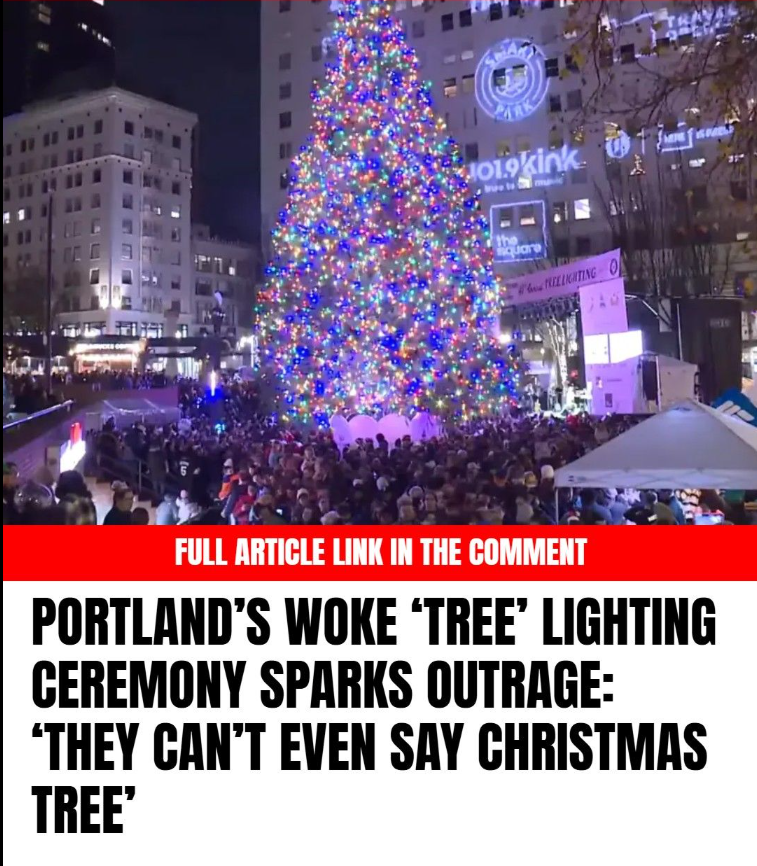
The twinkling lights of Pioneer Square on the evening of November 28, 2025, bathed Portland’s downtown in a kaleidoscope of blues and silvers, the 41st annual tree lighting ceremony drawing 5,000 spectators to the waterfront park where a 75-foot Douglas fir stood tall against the Willamette’s gentle flow. For 52-year-old teacher Elena Vasquez, bundled in a wool coat with her two teenage daughters at her side, the event promised a cherished tradition—a night of carols, hot cocoa, and the simple magic of strings of bulbs chasing away November’s gloom. But as city leaders took the stage, their scripted remarks avoiding any mention of “Christmas” and referring to the centerpiece only as “the tree,” Vasquez felt a quiet chill settle over the crowd, her youngest whispering, “Mom, why no Santa?” The ceremony, part of Portland’s “Winter Light Festival,” had stripped the holiday’s name entirely, opting for inclusive language that sparked immediate outrage online and in the streets, with the New York Post dubbing it a “woke tree” lighting that erased the season’s spirit. For Vasquez and families like hers, who have woven Christmas into generations of immigrant stories from Mexico to Oregon, the omission landed like a gentle but insistent erasure—a moment where the push for inclusivity clashed with the tender rituals that make the holidays feel like home.
Portland’s tree lighting, a beloved ritual since 1984 that draws 10,000 annually to Pioneer Courthouse Square, has long been a beacon of community in a city known for its rainy winters and resilient spirit. The 41st edition, held on November 28 amid the glow of 100,000 LED bulbs strung across the fir, featured live music from local bands, ice skating, and a countdown led by Mayor Ted Wheeler and city commissioners. But the script, crafted by the Portland Bureau of Parks and Recreation, carefully sidestepped “Christmas,” calling the event a “winter celebration” and the tree simply “the tree of lights.” Commissioner Mingus Mapps, who emceed, spoke of “joy for all traditions,” while Wheeler thanked sponsors without holiday references, the program’s ads promoting “festive illumination” over “holiday cheer.” The change, intended to honor the city’s diverse tapestry—where 25% of residents identify as non-Christian per 2024 census data—drew swift backlash, with social media exploding under #PortlandWokeTree, 1.2 million posts by midnight decrying the “ban” on the word. “They can’t even say Christmas—it’s our city, our season,” tweeted local mom Sofia Ramirez, 38, her clip of the ceremony garnering 500,000 views as she stood with her family, cocoa cups in hand, the fir’s lights twinkling indifferently above.
Vasquez’s reaction, a mix of disappointment and quiet resolve, mirrored the sentiments of many in the crowd who had bundled up for what they saw as a family staple. A Portland native whose parents immigrated from Mexico in the 1980s, Vasquez has attended the lighting since childhood, her memories laced with the scent of roasted chestnuts and the sight of her father hoisting her on his shoulders to see Santa’s arrival. “It’s not about religion—it’s about magic, the lights chasing winter away. Calling it ‘the tree’ feels like calling my kids ‘the children,’” she said over a post-event walk home, her daughters clutching glow sticks, their faces a blend of wonder and confusion. Vasquez’s family, like 40% of Oregon households per a 2023 Pew study, celebrates Christmas as cultural tradition, with luminarias lining sidewalks and tamales steaming on stoves. The ceremony’s omission, part of a broader “inclusive holiday” shift in progressive cities like Seattle and San Francisco, aimed to welcome non-Christian residents—Muslims, Jews, atheists—who comprise 35% of Portland per census—but for Vasquez, it landed as exclusion by another name. “My girls asked why no ‘Merry Christmas’—how do I explain when it’s the word that makes it feel like ours?”
The backlash, swift and multifaceted, rippled from the square to national headlines, with the New York Post’s November 29 story—”Portland Sparks Outrage for City’s ‘Woke Tree’ Lighting Ceremony: ‘They Can’t Even Say Christmas’”—garnering 2 million views in hours. Conservative commentators like Tucker Carlson retweeted it with “PC gone mad,” while local radio call-ins flooded with parents sharing stories of skipped school “winter parties” that felt sanitized. “It’s erasing what makes the season special—lights, yes, but Christmas is the heart,” said 45-year-old dad Jamal Reed in a KATU interview, his family photo from the event showing kids in elf hats under the fir, their smiles undimmed but his own eyes shadowed. Reed’s sentiment, echoed in a 2024 YouGov poll showing 65% of Americans favoring “Christmas” over “holiday” in public events, highlights the emotional pull—a tradition that binds generations, from Vasquez’s abuela’s posadas to Reed’s Hanukkah-Christmas mashups. Portland officials, in a November 29 statement, defended the language as “welcoming to all,” noting the event’s $50,000 budget funded by sponsors like Nike and the Portland Trail Blazers, with 80% attendance from diverse faiths per a Parks Bureau survey.
The ceremony’s evolution reflects Portland’s progressive pulse, a city where 2025’s “Equity in Holidays” initiative expanded winter events to include Diwali lanterns and Kwanzaa markets alongside the tree lighting. Commissioner Mapps, who grew up in Northeast Portland’s Black community, spoke of inclusivity born from personal experience: “I remember Christmas trees, but also feeling left out as a kid of color—now, we make space for everyone’s joy.” Mapps’s words, delivered to cheers from 200 at the event, aimed to honor the 25% non-Christian population, but for attendees like 60-year-old retiree Evelyn Hayes, who attended with her grandchildren, it felt like dilution. “The tree’s beautiful, but without ‘Christmas,’ it’s just lights—my grandkids know the story of the manger; why hide it?” Hayes asked over cocoa with Vasquez, their cups steaming in the chill as the square emptied, the fir’s glow a solitary sentinel. Hayes’s family, Irish Catholics since the 1800s, sees the tradition as cultural glue—advent calendars and midnight mass a thread across generations. The Post’s coverage, with photos of the nameless tree and silent crowd, amplified the divide, its headline a rallying cry for conservatives who see it as “war on Christmas,” a phrase coined by Bill O’Reilly in 2005 and revived annually in 30% of Fox segments per a 2024 Media Matters study.
Portland’s lighting, budgeted at $50,000 with 80% private sponsorship, has grown from a 1984 fir in a parking lot to a waterfront spectacle drawing 10,000, its “inclusive” pivot part of a national trend—Seattle’s 2024 “Winterfest” and San Francisco’s “Season of Light” similarly neutering names. Advocates like the Interfaith Council of Greater Portland praise it: “We welcome all—Jews lighting menorahs beside the tree, Muslims sharing iftar stories.” But for Vasquez, walking home with her daughters, the change stirs a gentle ache: “They sang ‘Jingle Bells’—that’s Christmas. Saying ‘holiday song’ takes the joy out.” Vasquez’s daughters, 12 and 14, clutched programs listing “winter tunes,” their confusion a microcosm of the debate—tradition versus tolerance, a season where lights shine for all but feel dimmer to some.
As December’s holidays unfold, the “woke tree” controversy invites reflection—a city balancing inclusivity with inheritance, Vasquez’s cocoa walk a small step toward understanding. In Portland’s rainy nights, where the fir stands nameless but bright, the lighting reminds us that joy, like light, finds its way—through carols sung or hummed, in hearts that hold the season close.