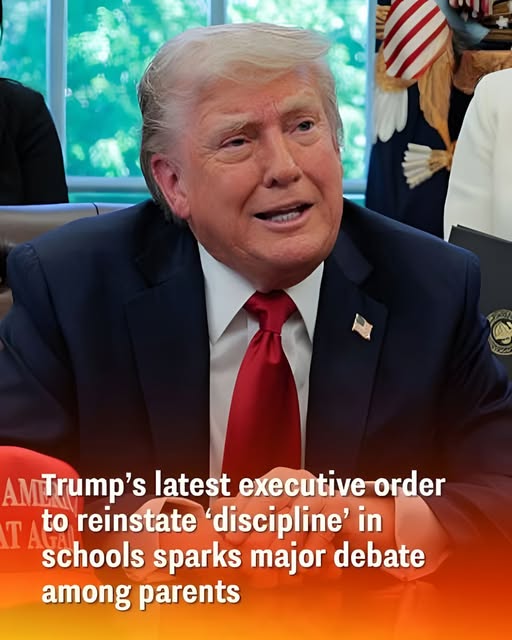
The administration of Donald Trump seeks to alter the disciplinary methods employed in schools, sparking significant discussion among parents.
On April 23, 2025, President Trump signed an executive order named ‘Reinstating Common Sense School Discipline Policies’, which aims to provide new guidance for K-12 educational institutions, with the objective of ensuring that school discipline policies are grounded in objective behavior rather than Diversity, Equity, and Inclusion (DEI), according to a White House executive order.
In a segment entitled ‘Restoring Excellence to America’s Educational Institutions’, it is stated: ‘President Trump places the needs of students, parents, and educators above the pressures from teachers’ unions, guaranteeing that policies are designed to benefit American families primarily.’
This directive contradicts the positions of his predecessors, Democratic presidents Joe Biden and Barack Obama, as it broadens his extensive reforms to the nation’s education system.
Under the Obama administration, there was a significant effort to address suspensions, expulsions, and other disciplinary measures that were identified as disproportionately affecting students of color, including Black, Latino, and Indigenous students.
In 2014, the Obama administration released guidelines indicating that Black students faced suspension rates over three times higher than those of their white counterparts, even for comparable offenses, as reported by PBS.
Schools were instructed that suspensions, expulsions, and involving law enforcement should be considered only as a last resort, emphasizing the importance of ‘restorative’ disciplinary approaches that allow students to remain in the classroom.
In the course of his initial term, the Trump administration reversed the initiative established during the Obama administration, and in December 2018, the U.S. Department of Education, under the leadership of Secretary Betsy DeVos, formally withdrew the guidance.
In May 2023, the U.S. Departments of Education and Justice, under the Biden administration, released a collaborative letter to public schools, encouraging them to review disciplinary data and practices to promote equity.
In the recent executive order concerning K-12 schools, President Trump has sought updated federal guidance on school discipline, asserting that the guidelines established by the previous administration had ‘essentially reinstated the practice of weaponizing Title VI to advance a school discipline approach rooted in a discriminatory equity ideology.’
The definition of ‘discipline’ is not explicitly clarified in the order; however, The Conversation suggests that it likely encompasses alternatives to suspensions, particularly emphasizing racial discrimination in such instances.
Tiffany Justice, a co-founder of Moms for Liberty, stated on X that Trump’s directive enhances the authority of local school boards by promoting genuine discipline. She emphasized that by curtailing federal interference, educators are liberated to concentrate on instruction rather than disorder, thereby guaranteeing that children receive a high-quality education.
This is not the type of discipline you intend to use to create discord! It is merely straightforward discipline! No disturbances! Otherwise, you must depart,
However, there is a lack of consensus among individuals. One individual expressed, ‘In one of the most egregious actions to date, Trump has enacted an executive order that facilitates teachers in ‘disciplining’ students within educational institutions. As a parent, I am truly horrified. I do not wish for Trump to dictate how my child should be disciplined.’
Judith Browne Dianis, the head of the Advancement Project, a civil rights nonprofit organization, stated that these executive orders represent yet another effort to undermine civil rights protections (as reported by NPR).
The Administration aims to reconstruct the school-to-prison pipeline; however, civil rights legislation explicitly states that educational institutions are prohibited from imposing harsher penalties on students based on race, color, national origin, sex, or disability.