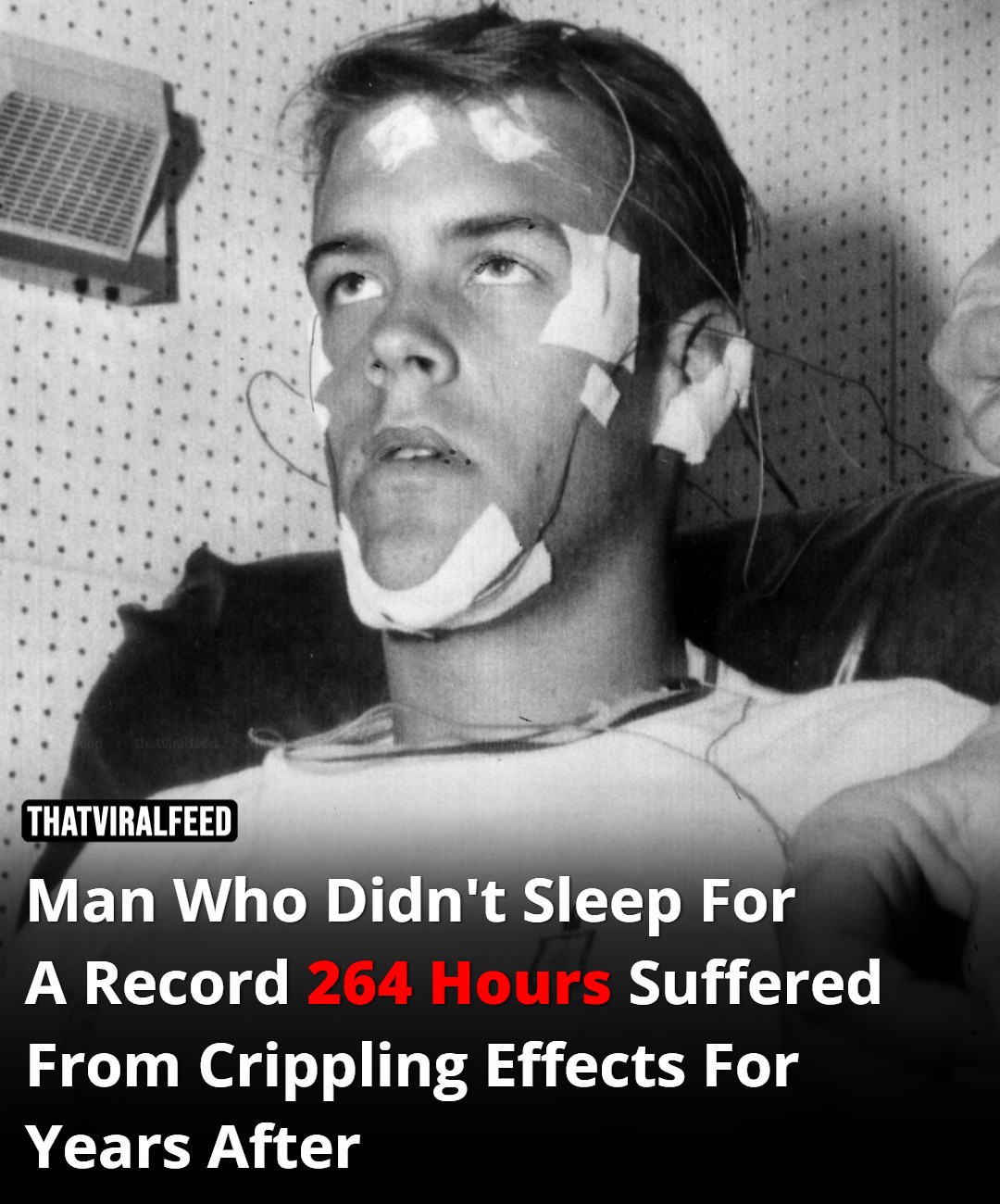
In 1963, two students in the US had an idea for a school science project, but little did they know that their experiment would have repercussions that lasted for decades.

The experiment in question involved testing the effects of sleep deprivation on the human body, and it led to one participant staying awake for a record-breaking 264 hours.
At just 17 years old, Randy and Bruce set out to accomplish what many would consider impossible: stay awake for as long as possible.
DJ in Honolulu set the world record for the longest time without sleep, staying awake for an incredible 260 hours – just shy of 11 days.
This feat inspired Randy Gardner and Bruce McAllister to attempt to break the record as part of their school science fair project.
Their project would ultimately have profound implications for the scientific community and Randy himself as he endured the physical and mental tolls of sleep deprivation for days on end.
“We were idiots, you know young idiots,
[The] first version of it was [to explore] the effect of sleeplessness on paranormal ability.
We realised there was no way we could do that and so we decided on the effect of sleep deprivation on cognitive abilities, performance on the basketball court. Whatever we could come up with.”
At one point, he told McAllister, “Don’t make me smell that, I can’t stand the smell,” the BBC reports.

Sometimes, the smallest decisions can have life-changing consequences.
As luck would have it, Bruce won the toss, leaving Randy to stay awake for as long as possible.
“I stayed awake with him to monitor him… and after three night of sleeplessness myself I woke up tipped against the wall writing notes on the wall itself,”
In a bid to achieve their goal, Randy and Bruce enlisted the help of another friend, and before long, sleep researcher William Dement from Stanford University joined their project.
With Dement’s expertise and guidance, the group was able to conduct a scientifically rigorous study of the effects of sleep deprivation on the human body.
Dement said:
“[Randy’s parents] were very worried that this might be something that would really be harmful to him.
The consequences of sleep deprivation are well-documented and can be truly alarming.

Lack of sleep has been linked to a myriad of health issues, including impaired memory, an increased risk of heart disease, reduced balance and coordination, and high blood pressure.
Despite his confident start, the experiment produced unexpected results when it came to his cognitive and sensory abilities.
Randy’s brain function began to deteriorate rapidly, and he found it increasingly difficult to concentrate or perform even the simplest tasks.
His grip on reality became tenuous, and he struggled to distinguish between what was real and what was a product of his sleep-deprived mind.
“He was physically very fit, so we could always get him going by playing basketball or going bowling, things like that.
If he closed his eyes he would be immediately asleep.”
This finding shed new light on the brain’s ability to function under extreme sleep deprivation conditions and highlighted the human mind’s incredible resilience.

Randy Gardner’s experiment lasted a total of 11 days (264 hours), during which he broke the existing world record for the longest period of time spent without sleep.
He slept for an impressive 14 hours there before waking up naturally, without feeling too ‘groggy’ or disoriented.
“I slept just over 14 hours. I remember when I woke up, I was groggy, but not any groggier than a normal person,”
However, as time went on, he began to experience the debilitating effects of decades-long insomnia.
“I was awful to be around. Everything upset me. It was like a continuation of what I did 50 years ago,”
Robert McDonald eventually broke Gardner’s record in 1986 by staying awake for a staggering 453 hours and 40 minutes, but after that, Guinness World Records stopped monitoring the record altogether due to the inherent risks involved.