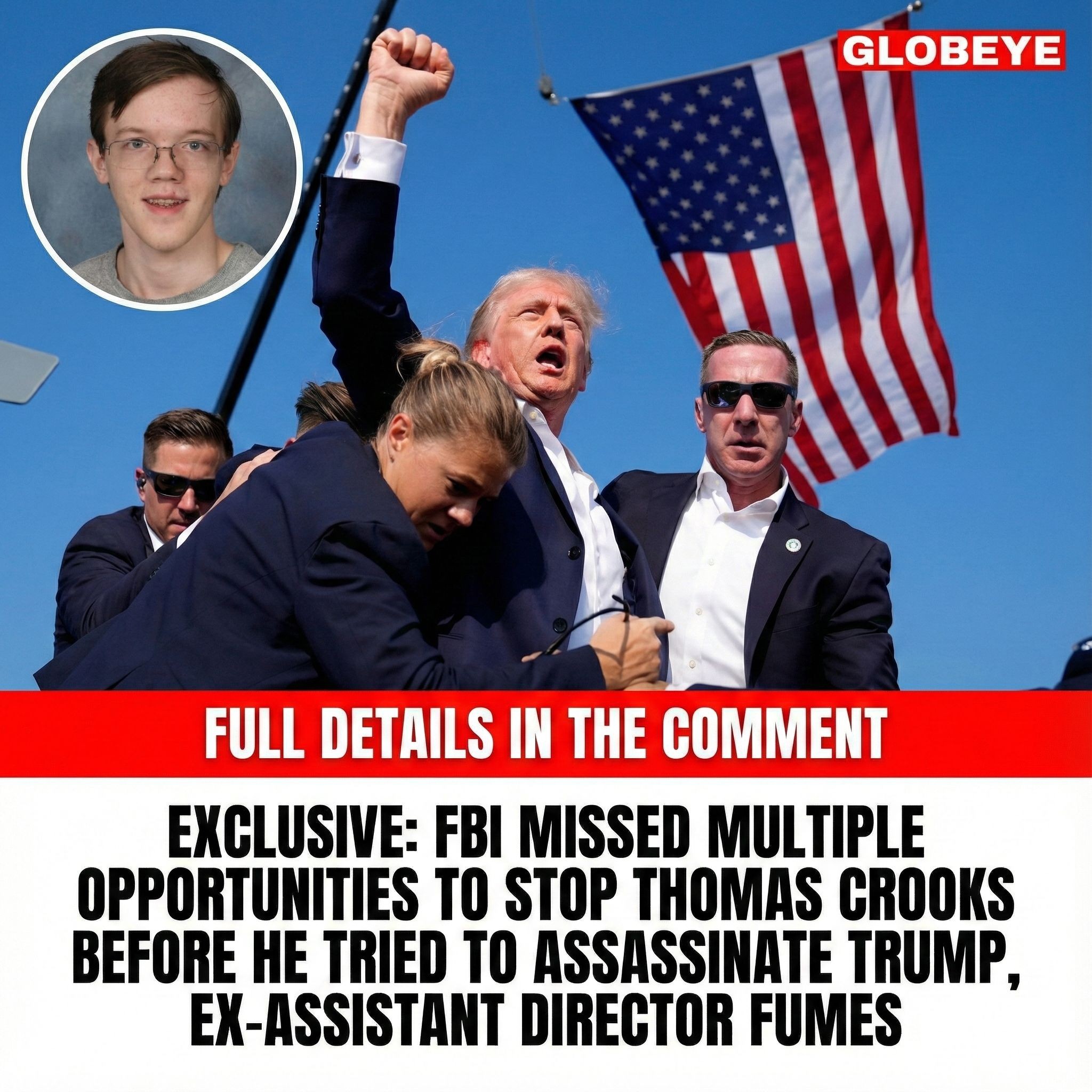
In the fading light of a Pennsylvania summer evening on July 13, 2024, as the crowd in Butler swelled with the electric hum of hope and the scent of grilled corn wafting through the air, President Donald Trump stepped to the podium, his voice rising like a rallying cry over the sea of red hats and American flags. It was a moment of unbridled optimism, a campaign stop meant to fire up the faithful in a swing-state stronghold, with families perched on blankets and children waving signs that read “Trump 2024: Make America Great Again.” But in an instant that etched itself into the nation’s collective memory, gunfire shattered the idyll—a single bullet grazing Trump’s ear, another claiming the life of Corey Comperatore, a devoted firefighter father of two who dove to shield his wife and daughter, and two more wounding innocent bystanders in a hail of chaos that left blood on the bleachers and terror in the hearts of thousands. The shooter, 20-year-old Thomas Matthew Crooks, a lanky high school graduate from Bethel Park with a rifle slung over his shoulder and a backpack of encrypted drives, was felled seconds later by a Secret Service sniper’s round. Yet, as the smoke cleared and Trump defiantly raised his fist, blood streaking his face, a deeper wound festered: how had this unassuming young man, whose online rants and erratic searches screamed danger, slipped past the watchful eyes of the FBI not once, but multiple times? Now, in a bombshell exclusive from the New York Post on November 23, 2025—over a year after the near-catastrophe—a former assistant director at the Bureau has broken his silence, revealing a series of “missed opportunities” that allowed Crooks to arm himself, climb that fateful rooftop, and pull the trigger. It’s a revelation that doesn’t just question competence; it pierces the soul of a nation still healing, whispering the agonizing what-ifs of lives forever altered by oversights that might have been averted.
To unravel this thread of tragedy, one must journey back to the quiet suburbs of Bethel Park, Pennsylvania, where Thomas Crooks grew up in a modest brick home on a tree-lined street that belied the storm brewing within. Born on September 20, 2003, to a behavioral therapist mother and a facilities manager father—both registered Republicans in a household that flew the American flag with quiet pride—Crooks was the picture of middling normalcy: a B student at Bethel Park High, where he graduated in 2022 with a handful of friends and a knack for math that earned him a spot on the rifle team. Classmates remember him as the awkward kid in oversized hoodies, more comfortable with code than conversation, his braces flashing in rare smiles during debate club or the occasional gaming session. “He was quiet, but not mean— just… distant,” one former teammate shared in a hushed interview with local outlet KDKA, his voice laced with the retroactive chill of hindsight. But beneath that veneer, Crooks harbored a digital double life, one that spiraled from innocuous memes to menacing manifestos, a descent into isolation that the FBI would later probe with forensic intensity but, according to insiders, failed to interrupt when it mattered most.
The first whispers of warning emerged in the spring of 2023, when Crooks, then 19 and fresh from community college classes in engineering, began posting under aliases like “Rod Swanson”—a nod to a fictional FBI agent from the TV show The Americans—on platforms from Discord to Steam forums. These weren’t idle chats; they were vents of venom, rants laced with antisemitic tropes, anti-immigrant screeds, and fantasies of political violence that escalated like a gathering storm. “Democrats deserve the rope,” one archived post read, shared in a now-deleted gaming chat where Crooks mocked mass shootings as “amateur hour.” Another, unearthed in a 2025 FOIA dump, praised the January 6 rioters as “patriots with guts” before pivoting to disdain for Trump as a “sellout.” Searches on his devices, later revealed in congressional hearings, included queries for “major depressive disorder symptoms” alongside bomb-making tutorials and the floor plans of the 2024 Democratic National Convention. Yet, as the New York Post’s exclusive interview with the former assistant director—identified only as “a senior Bureau veteran with direct knowledge of the case”—lays bare, the FBI had multiple touchpoints to intervene. In June 2023, a tip from a Steam user flagged Crooks’ posts to the FBI’s Internet Crimes Against Children task force, mistaking his violent rhetoric for a grooming lure; agents reviewed the account but deemed it “non-actionable chatter,” closing the file without a knock-and-talk. “We had the IP, the email—everything,” the ex-official told the Post, his tone a mix of disbelief and quiet fury. “A welfare check could have opened the door to counseling, monitoring, anything. Instead, we let it slide.”
That slide turned seismic by early 2024, as Crooks’ online odyssey deepened into obsession. Encrypted apps like Signal buzzed with his queries: “How to buy AR-15 without background check?” and “Trump rally schedules July 2024.” He donated a measly $15 to a progressive PAC in January, a possible feint, while scouring images of Trump, Biden, and FBI Director Christopher Wray. The second missed opportunity came in March, when Crooks’ school counselor, alarmed by his withdrawn demeanor and a flagged essay on “the ethics of assassination,” contacted local law enforcement, who looped in the FBI’s Joint Terrorism Task Force. Again, the ball dropped: a preliminary threat assessment rated him “low risk,” citing no overt threats or travel patterns, and the file gathered dust amid a backlog of 10,000 tips. The third, and perhaps most haunting, unfolded in May, when Crooks purchased 50 rounds of 5.56mm ammo from a local gun shop—his father’s old DPMS AR-15 in tow—and posted a cryptic Discord message: “July 13 is the day.” A shop clerk, uneasy about the volume, tipped off the ATF, which shared intel with the FBI. Yet, in a cascade of communication breakdowns, the alert never reached field agents in Pittsburgh, lost in the shuffle of siloed systems that the Post’s source blames on “post-Mueller reforms that prioritized quantity over quality.” “We had three pings on our radar—social media, school, purchase—and we whiffed every one,” the veteran confessed, his words heavy with the what-ifs that haunt retirees: What if a single interview had uncovered the encrypted drives? What if a welfare visit had pierced the isolation, connecting him to therapy before the rage metastasized?
The Butler rally itself was a powder keg of procedural pitfalls, where these oversights converged in catastrophe. Crooks, scouting the site days prior via drone footage later found on his phone, evaded detection despite local police flagging his “suspicious loitering” to the Secret Service— a handoff that fizzled in radio static. Perched on that sloped AGR building roof, 130 yards from the stage, he waited as Trump spoke of American resilience, his scope trained on the man who’d become his fixation. The shots—eight in rapid fire—ripped through the air at 6:11 p.m., Comperatore’s final act of heroism captured in heartbreaking footage as he shielded his family, his wife Helen later recounting to CNN the “wet warmth” of his blood and the silence that followed. For the Comperatore children, now fatherless at 6 and 8, the loss is a void that no investigation can fill; their GoFundMe, swelled to $7 million by donors moved by Corey’s selflessness, stands as a testament to a community’s grief. Trump’s wound, a superficial graze that required no stitches but left a permanent scar, became a symbol of defiance—his bloodied fist pump a rallying cry that propelled him to victory in November. But behind the heroism lurks a profound sorrow: the two other victims, David Dutch and James Copenhaver, both 57-year-old steelworkers who spent months in rehab learning to walk again, their families upended by surgeries and setbacks.
The Post’s revelation, drawn from hours of interviews with the ex-assistant director—a 28-year Bureau lifer who retired in 2024 amid the post-shooting purge—paints a bureau adrift in its own bureaucracy, a far cry from the J. Edgar Hoover era of unyielding vigilance. “We had the dots; we just couldn’t connect them,” he lamented, pointing to understaffed field offices and algorithmic blind spots that prioritized overseas threats over domestic lone wolves. This echoes the 2025 congressional report from the House Oversight Committee, which slammed the FBI for “systemic failures” in threat assessment, recommending AI overhauls and mandatory cross-agency drills. Under new Director Kash Patel, Trump’s handpicked reformer sworn in February 2025, the Bureau has pledged transparency: a November 21 statement affirmed Crooks acted alone after 480 agents conducted 3,000 interviews worldwide, scouring his “limited” online footprint—from Discord rants to a $15 PAC donation that baffled profilers. Yet, Patel’s team disputes the “missed opportunities” narrative, insisting tips were “vetted and deprioritized appropriately” amid 20,000 daily leads. Critics, including Sen. Chuck Grassley (R-Iowa), call foul: “If three red flags aren’t enough, what is?” he thundered in a floor speech, his words a clarion for accountability.
For those touched by the bullets—Comperatore’s widow, now a single mom navigating bedtime stories without her rock; Dutch, relearning to hug his grandkids with phantom pains—these revelations reopen wounds that time hasn’t sealed. “Corey would want answers, not excuses,” Helen Comperatore told the Post through tears, her voice a quiet thunder that demands more than memos. Trump’s response, a fiery Truth Social post on November 23 vowing “full justice for the FBI’s failures,” resonates with a base still seething from 2020’s shadows, but it also invites balance: the Bureau, for all its stumbles, neutralized 150 threats in 2024 alone, per annual stats. As winter looms with its promise of reflection, this saga isn’t schadenfreude—it’s a somber summons to safeguard the republic’s guardians, ensuring the next rally rings not with gunshots, but with unmarred unity. In Butler’s healing fields, where wildflowers now nod over that scarred stage, the true measure of progress lies not in blame, but in building barriers against the darkness that dares to dim our dawn.